
Sam Chatto, Princess Margaret's grandson, got engaged to Eleanor Ekserdjian this week, and the ring is what everyone's talking about. As a professional ceramicist, Sam proposed with one of the most unconventional and romantic rings I've seen in a long time: a porcelain ring he made himself. I spoke to GB News about what that choice means for anyone considering an alternative engagement ring material (the piece also ran on AOL):
"Sam Chatto's choice of a porcelain engagement ring is an incredibly charming and personal gesture, designed in the medium he knows best. However, in the jewellery world, wearing a porcelain ring as a daily piece is virtually unheard of because clay is simply too delicate for modern life."
Think of your favourite mug that shattered. Porcelain simply doesn't have the tensile strength to take the knocks a typical engagement ring will absorb without thinking, door handles, kitchen counters, going on the tube. Although, if his fiancée happens to break it, the wonderful thing is that Sam can always make a new one!
Having said that, I'm pretty sure this porcelain ring is simply a wonderful, highly sentimental proposal ring, and that Sam and Eleanor will design an engagement ring fit for daily wear together somewhere down the line. But it got me thinking about the advice I'd give any couple looking for a ring that's going to last through the decades of a long and happy marriage. So, here's everything you need to know about picking an engagement ring that will go through the highs, the lows, and the daily knocks of life with you.
Choose a metal built for daily wear
Precious metals have earned their reputation over thousands of years. Look at Roman or Egyptian jewellery that's survived intact underground for two millennia, and you can understand exactly why gold has been valued for so long. It's inert, meaning it doesn't react with your skin, the air, or anything you come into contact with day to day, and it's both durable and beautiful.
If gold isn't quite you, platinum is worth considering too. It's exceptionally strong, and unlike most white golds, it will not need rhodium plating to keep its colour. Gold and platinum rings can also be resized over the years as your fingers change (although this slightly depends on the design), which isn't true of more unconventional materials or more unusual metals like aluminium or tungsten unless you find a specialist workshop.
Choose the right gems
The main thing most engagement ring guides get wrong is about gem hardness and durability. As a gemmologist it's the bit I always try to explain early, before you fall in love with a stone.
Gemmologists measure hardness, or scratch resistance, using the Mohs scale: a simple 1 to 10 ranking of how easily a material scratches. Diamonds sit at 10 as the hardest natural material on earth, while sapphires and rubies sit at 9 (you can see them on the graph below under their gemmological name Corundum). This isn't always the best indication of actual hardness, as diamonds are exponentially harder than sapphires despite being next to each other on the scale, but it can give you a good idea of how scratch resistant a gem will be. You might have already heard of this and thought that was all you needed to know.

Mohs scale graphic © GIA
However, hardness only tells you whether a stone will scratch. It doesn't tell you whether it will crack or shatter with one sharp knock. That's toughness, and the two don't always go together. While being by far the hardest gemstone, diamonds aren't perfectly tough. They can chip or even shatter if you hit them at exactly the right angle, due to something called perfect cleavage, meaning they're not indestructible like some people think they are. It is, however, rare that someone will shatter a diamond, as you have to be pretty unlucky to catch them at that angle.
You may have heard emeralds are too soft to wear in an engagement ring. In fact, emeralds are fairly hard on the Mohs scale, meaning you won't easily scratch them with everyday wear. They are typically full of natural inclusions that make them brittle, though, so they can chip or crack with a sharp knock, meaning they're not the best choice for an engagement ring. Opals and pearls are also not great choices for engagement rings as they are both soft and porous, so they scratch easily and can be damaged by everyday things like perfume or cleaning sprays.
For engagement rings, the best options that are both hard and tough are diamonds, sapphires, and rubies, which is exactly why they've stood as the standard for so long. If you want colour without compromising on daily wear, sapphires and rubies are my first suggestion. It's also worth remembering that sapphires come in almost every colour of the rainbow, so they'll always be a strong choice for a colourful engagement ring.
A bespoke Aril Jewels engagement ring with a round brilliant cut diamond and blue, pink, green and purple sapphires.
All of that said, this is ultimately personal preference, and I'm not in the business of telling someone they can't have what they love. If you fall for a stone that's not perfect for an engagement ring, like an emerald, or an opal, or a tanzanite, that's your ring and your choice. What matters is knowing what you're getting into, and making sure the setting is doing some of the protecting for you. This is where a trained gemmologist is going to be able to give you the best advice.
I have a rainbow moonstone ring I wear most days. Most jewellers would advise against this, and it's true, it is a little more delicate than my other rings. But I know it's softer, I wear it on my left hand so it takes less of a battering, and I've had the stone repolished twice. It's set in a relatively protective setting, and I'm aware that one day I may need to replace the stone. Similarly, I made an emerald engagement ring for a good friend who'd been dreaming of an emerald for years. She understood it would need more care than a diamond would, and we designed the setting to protect it and kept the stone in a shape less prone to chipping.
Setting styles that protect the stone
A hard, tough stone in a flimsy setting is still a fragile ring, so the setting matters just as much, if not more, than the gem itself.
For anyone with an active lifestyle, I nearly always recommend one of two settings. Either a rub-over (also known as a bezel) setting, where a frame of metal wraps fully around the gem. We use this in our Clara collection, with fine millegrain detailing cut by hand to keep it feeling more feminine rather than too clunky. Or a Georgian-inspired cut-down setting that works on the same principle, with metal surrounding the gem and the illusion of claws cut into it, which is what we use across our Georgiana collection. Both protect the stone from every angle, making the gem far more likely to survive daily knocks.
Aril Jewels Georgiana Diamond Solitaire Ring with an antique old European cut diamond in a Georgian-inspired cut-down setting of platinum.
Claw or prong settings are beautiful for showing off a stone in its entirety, but the fewer claws you have around a gemstone, the more vulnerable it is. Claws wear down the same way anything worn every day does. Think about how the soles of a pair of shoes worn daily for years end up thin. The same thing happens to the metal on your rings. When the metal of your claws wears too thin, claws can peel back or break off, and that's how stones get lost.
The points, edges, and corners of a stone are always the most vulnerable part, whatever the shape, so if you are going with a claw setting, it's always worth making sure those points are protected. There's nothing more horrifying to a jeweller than seeing a gem like a marquise, set where the points of the stone are not covered by a claw.
You can see in this bespoke sapphire engagement ring we made, the marquise sapphire has each point protected by an 18ct gold claw while the points of the pear-shaped diamond on each side are protected by platinum claws.
Band thickness and everyday wear
It's easy to focus entirely on the stone and forget the band itself takes just as much daily impact, if not more. Very thin bands wear down over years of contact and can bend out of shape if they're made too slim. If you're planning to wear your engagement ring stacked against a wedding band, it's also worth thinking about how the two will sit and rub against each other daily, since the wrong pairing can wear both rings down faster than either would alone. When designing engagement rings, we always consider how the wedding band will be worn so that we make sure the two rings will work together as seamlessly as possible. Unfortunately, not all jewellers do this.
A good rule of thumb is to avoid your rings rubbing at too many points, particularly if they're rubbing along the settings of your gems. In an ideal world, it's also worth using the same metal for your wedding band as the point of contact on your engagement ring, since they'll then wear at the same rate. Pair a platinum band against a yellow gold ring and the yellow gold will wear away faster, which is worth being aware of before you commit to two different metals.
One of my pet peeves is a delicate claw setting on a wafer-thin band. It photographs beautifully, but you're combining the two most vulnerable elements of a ring into one piece. An engagement ring should be built to go the distance, not just look good on the day of the proposal. Add a wedding ring where diamonds are set so that the girdles (outside edges) of the diamonds can cut into your engagement ring and it's the stuff of nightmares!
A little upkeep goes a long way
The best advice any jeweller will give you is simple: take your ring off when you're doing anything physical with your hands. I personally take mine off when I get home, so chores around the house don't give them a battering. Please, please take your rings off at the gym, especially if you're lifting heavy weights, and the same goes for gardening!
All of this advice goes triple for a ring with stones set the whole way around. Diamonds are the hardest natural material there is, but they're not indestructible. I've seen full eternity rings with even diamonds shattered by a hard knock at the gym or an enthusiastic clap, since the stones at the bottom of your finger take the worst of the daily wear. If you're sold on a full eternity ring, one advantage of the design is that it spins naturally on your finger over time, so that wear gets distributed around the ring rather than staying fixed in one place.
An engagement ring with a single stone, for example, and then gems set the whole way around the shank and shoulders is a different story, and one I'd actively avoid. Because you're always keeping the main stone facing up and outward, the ring doesn't spin the way a full eternity band does. That means it's always the same diamonds and the same section of metal at the bottom of your finger absorbing every knock, while the ones on show at the top see almost none of it. I wouldn't make a ring like this because it's only a matter of time before you start to lose those gems at the bottom.
It's also worth noting that resizing either style is mostly impossible, though a skilled jeweller can occasionally manage it with care.
Beyond your own daily habits, even the most durable ring benefits from professional care. Have it checked once a year to make sure the settings are secure, since metal can wear and gems can work loose over time without you noticing. Catching any problems early saves you from a far more expensive repair, or a lost stone, later on. It's also worth insuring your ring properly, ideally with a specialist jewellery insurer rather than standard household cover.
Store your jewellery apart from each other
It's not just wear on your hand that damages a ring. Diamonds are hard enough to scratch almost anything else, including other jewellery, so if your rings are thrown together in a drawer or a jewellery box pouch, they can damage each other. An unprotected diamond girdle, the sharp edge running around the widest point of the stone, will cut into the metal of a softer setting surprisingly quickly if the two rub together. Store your rings separately, in individual pouches or compartments, and you'll save yourself a repair bill down the line.
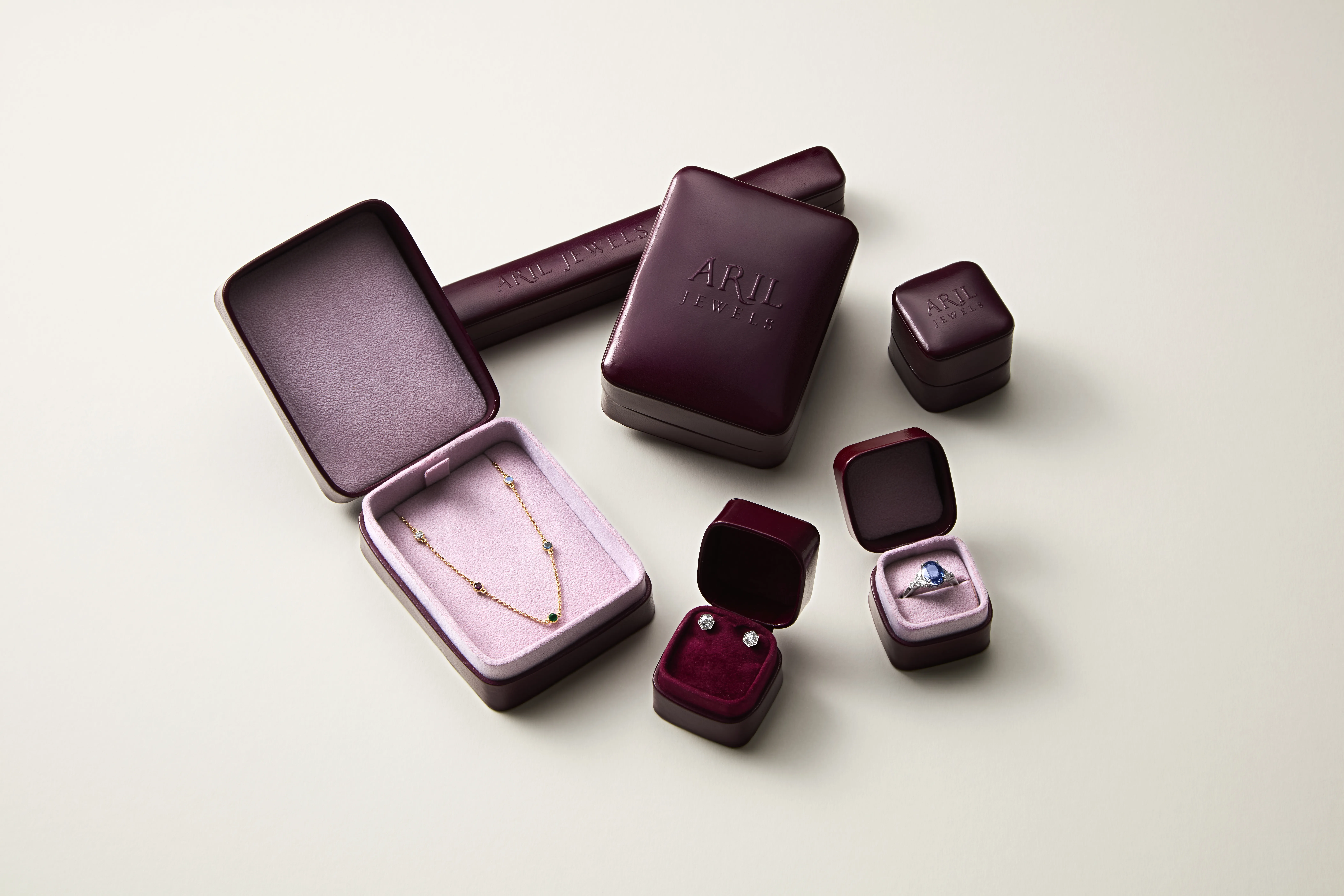
The original boxes your jewellery came in are always good for this, pictured are our handmade leather jewellery boxes.
A note on antique jewellery
If you know me, you'll know that I absolutely love antique jewellery. One thing worth knowing, though, is that an antique ring is rarely as durable as a newly made one, however beautifully it was made. The people who originally wore these rings weren't hauling shopping bags or commuting on the tube. We don't have domestic servants catering to our every whim anymore, so our jewellery has to do a different job than it did a century ago. If you love an antique design, having it remade in new metal with a modern setting made for modern wear, gives you the look with none of the fatigue.
If you're at the start of choosing an engagement ring and want a second opinion on a design, a stone, or how a particular setting will actually hold up to daily life, that's exactly the kind of conversation I love having. At Aril Jewels, every piece is made by hand in our London workshop, and durability is something we design in from the very first sketch, not an afterthought once the design's already decided. If you'd like to talk through your own ring, whether that's choosing a stone, adapting a design, or starting something bespoke, I'd be very happy to help.
You can either get in touch, or book your free jewellery chat, to ask any questions and chat through your ideas.
About the author

Chloë Woodmansterne FGA DGA
Chloë Woodmansterne is the founder of Aril Jewels, a fine jewellery brand based in London which specialises in historically inspired engagement rings and fine jewellery, made by hand using antique old-cut diamonds and richly coloured gemstones. She studied History at university and has worked in the fine jewellery trade for over 15 years, including for some of the UK's most prestigious jewellery houses. She has been a qualified gemmologist (FGA DGA) since 2012. Aril Jewels has been a finalist at the NAJ Awards, the UK Jewellery Awards, and the Professional Jeweller Awards.


